Tuesday, 21 May 2013

An Introduction to Four of the 'Ms'.... (Part 1)

Mosques, Minarets, Madrassas (Islamic school and universities) and Mausoleums.... (The other m's - meals, markets and monuments I'll save for future posts.)

At this stage the photos, which are in no particular order,  provide just a taste of some of the glorious buildings we encountered and give you a sense of the ancient landscapes that dotted the Silk Road. (I will go into a little more detail later on and focus on some of the wonderful designs that filled my head and my camera....).

The general range in age is from about the 9th century to the 15th century - give or take a few years here and there. The condition of the structures also ranges from original remnants to repaired and restored, or completely rebuilt,  depending on the ravages of earthquakes and conquerors or intervention by bodies such as UNESCO - who are doing a great job to protect many sites listed as World Heritage Areas.


                     (Although it was bitterly cold that day it's salt on the ground, not snow.)


Interestingly I didn't tire of looking at these but the modern versions left me cold........I'll post some more photos that Bob took later on - my card was full at the time - bugger!!
Sue xxxx

Saturday, 18 May 2013

Silk

What would the silk road be without a mention or two of silk in all its glorious forms? (No, the answer is not rhubarb this time...)

My long anticipated visit to the 'Yodgorlik Silk Factory' in Margilan, (Fergana Valley, Uzbekistan) in many ways created more questions than it answered. There have been several collaborations with the British Council which has brought the factory and the cloth to the attention of designers which in turn has brought attention to the cloth and its production. I understand it started as a public enterprise but is now privately owned - unfortunately time didn't permit a more detailed investigation so any errors / views are mine - with apologies if incorrect.

The timing of our visit meant that we were not there when the place was in full production, however we were able to get some insights into the processes helping to keep the traditions alive - with one big 'but'...(more on that later), and I did find a Youtube video link which explains things in more detail. Careful observation will also give a picture of working conditions......

https://www.youtube.com/watch?v=2WtqyNy9woM&feature=youtube_gdata_player

                                              A few cocoons left from last season......


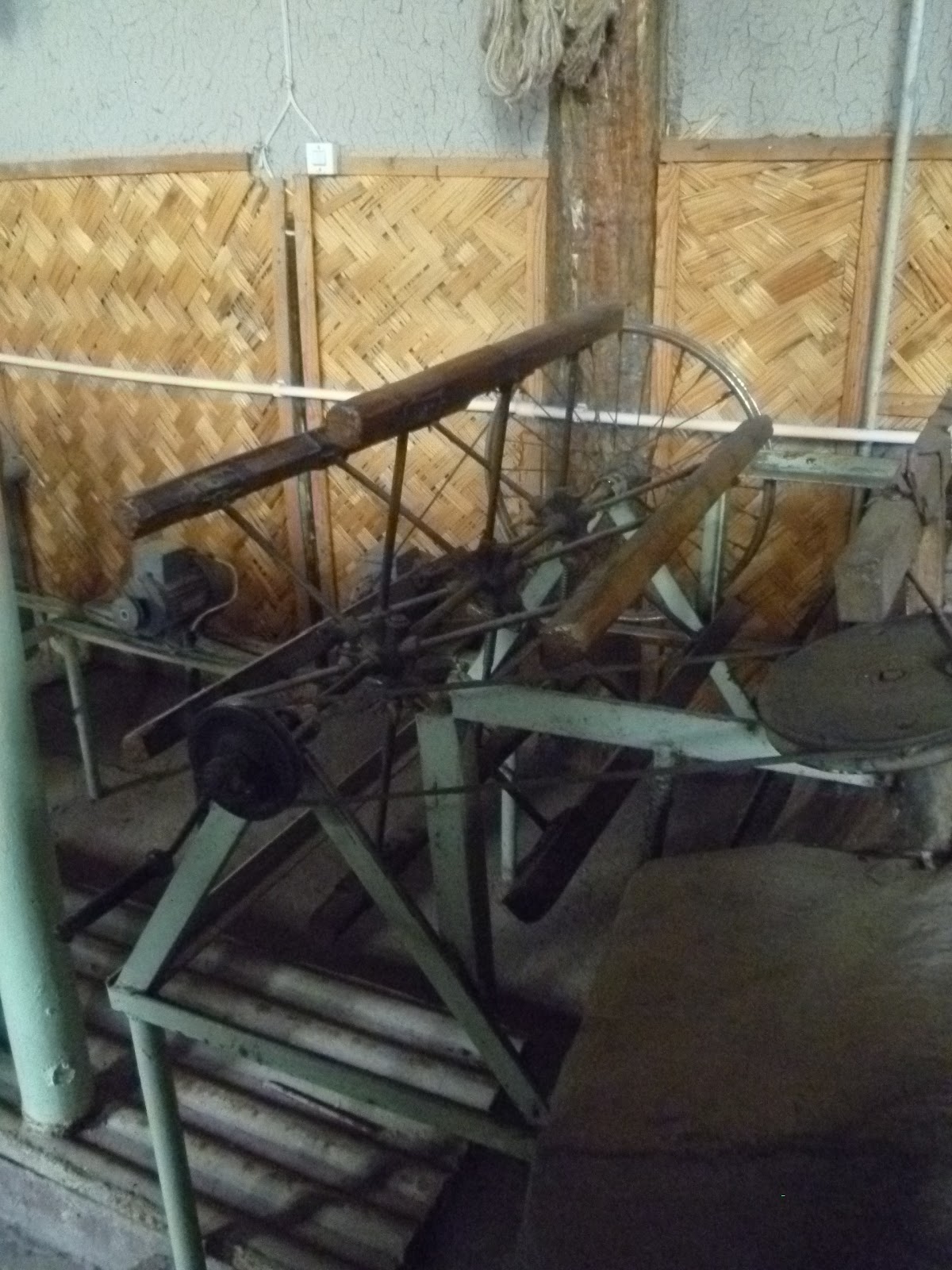
.....hand-operated winder......


Wound thread ready for scouring.......(before)


                                                    ........after. (The thread feels quite stiff.)


Some of the natural ingredients used to create and mix the dyes.


The dyes being mixed (over heat) in large vats.


                                                The damp, resist tied skeins of thread.............


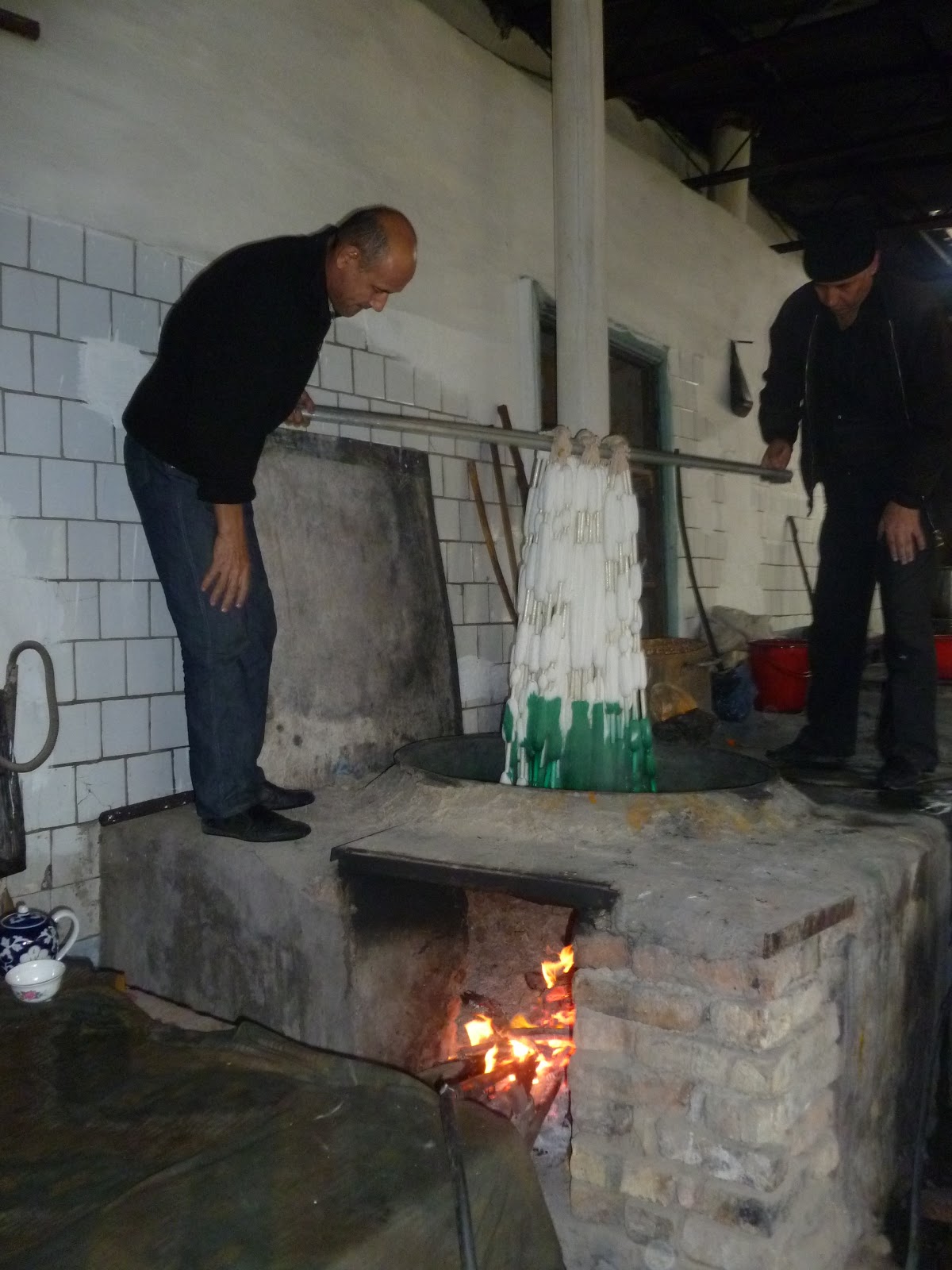
These were picked up on two poles and then dunked into the dye mixture.

By manipulating the poles the two dyers were able to move the hot threads around and dunk different sections into the dye - the same process would be used to overdye different sections into different colours.


A sample of finished dyed thread prior to removing the resists......

Threads ready for the weavers and carpet makers to use. I searched everywhere I could in an attempt to purchase some of these threads but time / tour constraints meant I came home empty handed.


Carpet weavers at work.....


                                                 ...and some enjoying a 'tourist ' break........

The hand looms in the factory. Only a few in operation. (I'm not sure how the work hours are determined, or the rates of pay.)


                                                                 Tying the fringes.........


Now here's my big 'BUT'.......

The production here was described as not machine woven but 'woman by machine'......yes, there did appear to be many adjustments made by the women working at the time but the noise in here was indescribable. The machines were like those out of Victorian industrial times - it was unimaginable what it would have been like if every machine in the room had been working rather than just two or three and no ear protection of any sort in sight.


We spoke to our guide who seemed quite baffled that we should find it an issue and maintained that there were no hearing problems. We could not tolerate the noise for more than five minutes.

Here lies a somewhat ethical dilemma.

Do we continue to purchase cloth produced under these conditions? Does it mean that by purchasing the cloth we help maintain some wonderful traditions and create jobs which otherwise might not be available? Or do we condemn other people (mostly women) to work in conditions that put their health at serious risk?
(Our visit coincided with the collapse of the clothing factory in Bangladesh which killed over a thousand workers....)
I would appreciate any views on this.


Some of the extraordinary cloth produced there..... 


And yes, I did buy some - one hand-woven piece...

.....and one 'woman by machine' piece.


I paid what I considered a fair price in local terms and can only hope that the women who made them received fair wages for their work,(though there did seem to be a large car parked in the owner's driveway......)

Sue xxxx

Thursday, 16 May 2013

Rhubarb - Part 2........


As I mentioned in an earlier post I would be looking out for rhubarb on my travels along the 'Silk Road'. (If you are just joining me there was a valid reason, I promise - see original post 'Rhubarb'.)

Well, I found it.

First up in a market in Samarkand, Uzbekistan........

(Maybe not the ruby red ours is, but certainly rhubarb.)


(This gent asked to have his picture taken, too.)


Then being sold at a market in Uzgen, in Kyrgyzstan.......


by two delightful women who thought it was absolutely hilarious to see their photos in my camera ...........and no doubt thought I was crazy.....


It was growing wild in the mountain pass of Chichkan Gorge.....


.....on the banks of a remnant of a wall at the Burana Historical Complex.....


which archeologists believe to be either part of a palace wall or temple complex from the ancient town on the site dating back to the 10th century and earlier. 


.....close to the Burana Minaret.....


The minaret survived Ghengis Khan but lost it's top in an earthquake in the 15th century. The octagonal base has also been restored as over the years the locals had been removing bricks for their own buildings. 


(The view beyond the complex...)


......and along the roadside between Bishkek, capital of Kyrgyzstan and Almaty in Kazakhstan.


Although it seemed to be readily available I saw no indication of how it is used today - whether it's food or medicine - so it's still a bit of a mystery as to why it was so important to the ancient traders and travellers.

I'm a bit relieved the name 'Silk Road' was conjured up as I have far more to say on that topic. (What a surprise!) Definitely more interesting than rhubarb...........


(A sneak peek of what's to come, but I think you'll agree.)


Sue xxx


Tuesday, 14 May 2013

Home Sweet Home


Home to this calming view from our bedroom window after a jam-packed, amazing trip to Central Asia. A decent flat white (or two), 12 hours solid sleep and numerous cups of my favourite tea and I'm beginning to find the mental space needed to work through all that we've seen and done. (Naturally with the help of the several thousand photos we took between us - but don't worry, you won't be subjected to them all.........) 

I'm planning to blog in small snatches - that way you can choose your own 'slideshows' if you are interested - or not, as the case may be. I'm hoping to make a start tomorrow........(The blog is mainly for me but you're welcome to tag along at any time.)

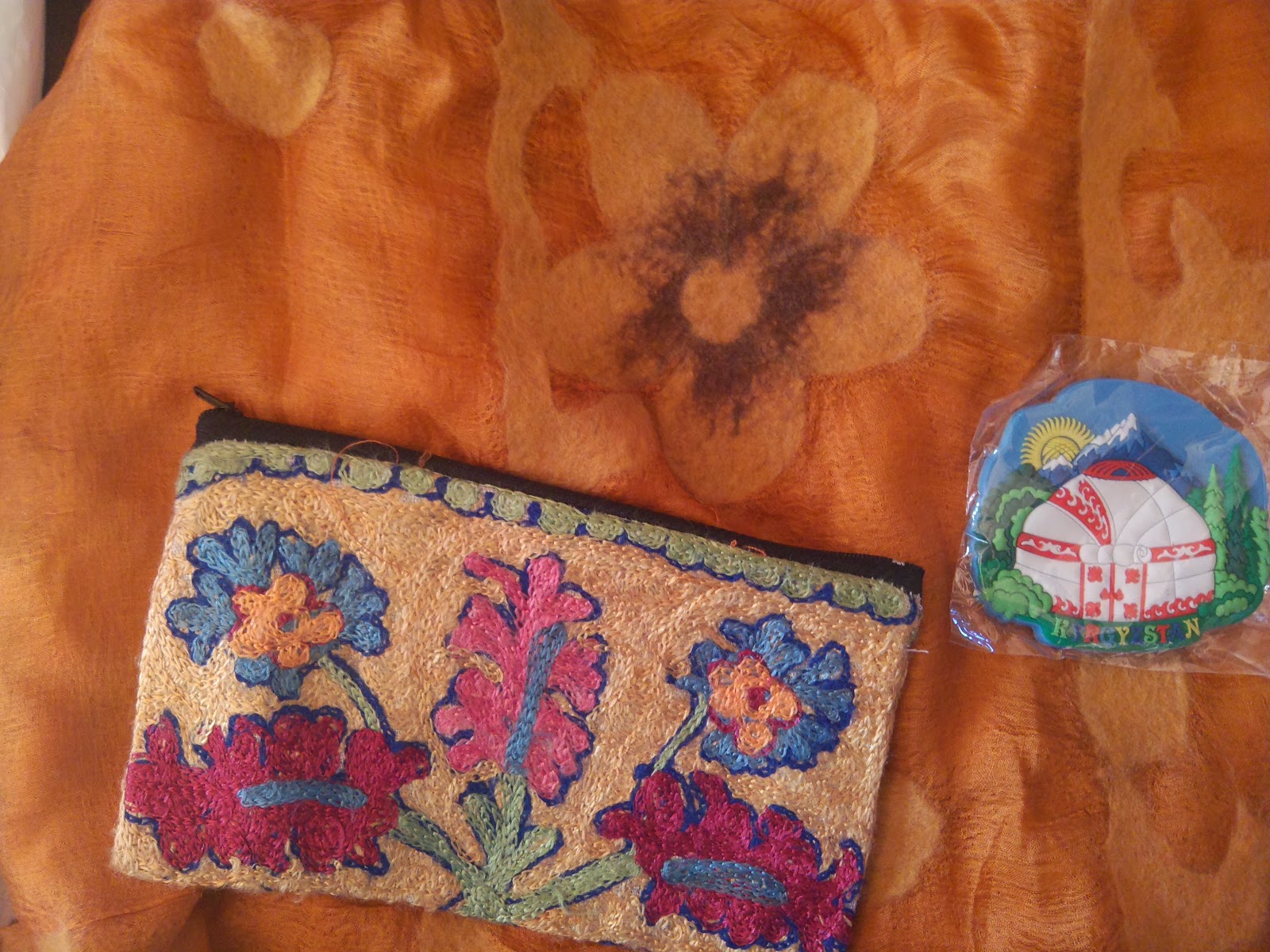
Below is a tiny sample of the shopping - a gift for our wonderful neighbour who looks after things when we are away. (Much more still to be photographed......)


Sue xxxx